
AI for Content Repurposing | How to Turn One Blog Post Into 10 Pieces of Content | Intelliewrite
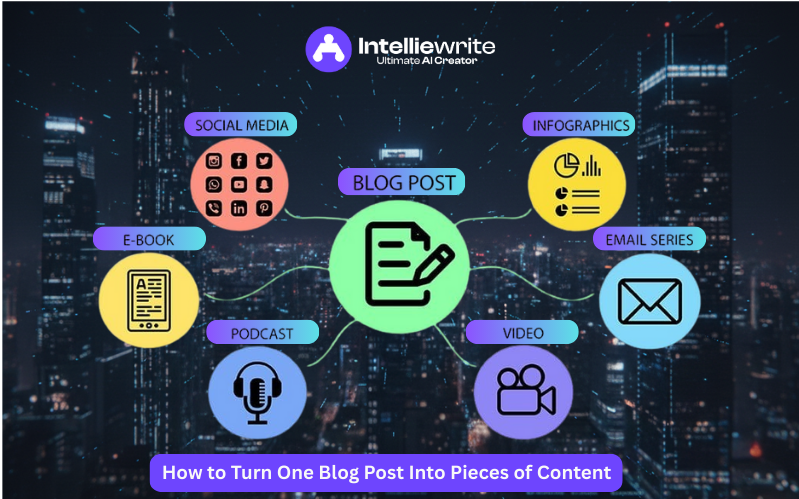
You don’t need more content. You need more outcomes per piece. In my experience, AI for content repurposing is the fastest path to scale without burning out your team. This guide shows you how to turn a single blog into 10 assets, optimize each for platform intent, and keep quality high. You’ll see exactly how Intelliewrite accelerates the workflow, what to watch for after Google’s March 2024 update, and how to measure impact.
To repurpose one blog post into 10 assets: extract the thesis, map to channels, prompt Intelliewrite with audience and format, fact-check and human-edit, and schedule platform-native versions with UTM tracking.
Why AI for Content Repurposing Matters in a Saturated Landscape
Search is stricter, feeds are noisier, and attention is fragmented. Google’s March 2024 core update aims to reduce low-quality content in search results by a large margin, prioritizing originality and usefulness. That means fewer thin rewrites and more platform-native, people-first assets.
AI for content repurposing gives lean teams leverage. You scale outputs while protecting editorial standards. In practice, I’ve seen one well-researched blog drive a month of distribution when remixed intelligently.
- Extend lifespan: Refresh angles quarterly without rewriting.
- Meet intent: Shape format to how each platform is consumed.
- Improve ROI: One research effort, many measurable touchpoints.
According to industry reports in 2024, short-form video remains a top ROI channel, while resource constraints persist for content teams. Repurposing reconciles both realities with smarter reuse, not more work.
From One Blog to Ten Assets: Formats That Convert
Start with a strong thesis, then break it into modular ideas and stories. Use the blog’s subheads, data points, and examples as your building blocks. Here are 10 high-performing derivatives I use repeatedly:
- LinkedIn carousel: 7–9 slides summarizing key insights.
- Short-form video: 30–60 seconds with a hook and CTA.
- Twitter/X thread: 6–10 tweets distilling arguments.
- Podcast mini-episode: 5–8 minutes on one takeaway.
- Infographic: Visualize the process or data from the post.
- Email newsletter: Curated summary plus a personal note.
- Slide deck: For webinars or sales enablement.
- Checklist/cheatsheet: Tactile step-by-step utility.
- Quora/Reddit answer: Adapted to community tone.
- Republished “lite” post on Medium with canonical URL.
Tip: Assign each format a micro-CTA aligned to the funnel stage. For example, a carousel for awareness, a checklist for consideration, and a deck for sales conversations. Add UTM parameters so each asset’s performance is traceable.
Using Intelliewrite for Fast Adaptation Without Losing Quality
Intelliewrite accelerates repurposing by turning long-form drafts into platform-native outputs with guardrails. The goal is speed plus fidelity to your voice and facts. Here’s a practical workflow I recommend:
- Create a style profile: Tone, POV, banned phrases, and brand terms.
- Feed the source blog: Include outline, key stats, and original sources.
- Select target formats: Choose from preset templates for carousels, shorts, and emails.
- Add audience and platform: ICP, stage, and channel (e.g., LinkedIn vs. TikTok).
- Generate drafts: Batch outputs with confidence scores and reasons.
- Human edit: Verify data, add lived experience, and insert first-party examples.
Distribution matters. Use Intelliewrite’s prompts to tailor to each channel’s structure:
- LinkedIn: Hook in the first 2 lines, 1–2 emojis max, 3 hashtags.
- Shorts/Reels: 3-second hook, on-screen captions, 1 point per clip.
- Email: A clear subject line test, 1 CTA, scan-friendly sections.
Always preserve attribution. Link original sources, cite dates, and embed canonical tags when republishing to avoid duplicate content issues.
Best Practices to Maximize Longevity and Trust Signals
Repurposing works when quality compounds. After Google’s Helpful Content evolution, it’s crucial to demonstrate experience, expertise, authoritativeness, and trust in every derivative.
- Lead with experience: Add “In my experience” notes and specific outcomes.
- Protect originality: Avoid scaled, near-duplicate variants across platforms.
- Refresh quarterly: Update stats and screenshots; log change history.
- Bundle assets: Package related derivatives into a resource hub.
- Measure resonance: Track saves, replies, completion rate, and assisted conversions.
Governance helps. Create a repurposing matrix mapping formats to funnel stages, approvals, and KPIs. Document your review checklist: fact-check, bias check, brand voice, and accessibility (alt text, captions, contrast).
Practical Application: A One-Week Sprint Plan
Here’s a sprint I run with startups and mid-market teams. It produces ten assets from one post without chaos.
- Day 1: Select a cornerstone blog. Extract thesis, claims, and data.
- Day 2: In Intelliewrite, generate drafts for 5 formats. Add platform notes.
- Day 3: Human edit. Inject anecdotes, case specifics, and source links.
- Day 4: Produce visuals. Carousels, thumbnails, and infographic sketches.
- Day 5: Generate the remaining formats. Record a mini podcast and short video.
- Day 6: Schedule and tag UTMs. Build a Notion tracker for KPIs.
- Day 7: Ship, monitor, and respond. Note qualitative feedback.
Common pitfalls to avoid:
- Publishing the same copy across platforms.
- Skipping citations and dates on statistics.
- Over-automation without a human pass.
Expert Insights
“Repurposing isn’t copy-paste; it’s translation. Match the message to the medium.” — Amanda Natividad, VP Marketing at SparkToro
“AI is your accelerator, not your author. Human editing is where trust is earned.” — Lily Ray, Senior Director, SEO at Amsive.
“Canonicals and context protect SEO equity when you syndicate.” — Barry Adams, SEO Consultant at Polemic Digital.
According to Google’s 2024 guidance, originality and helpfulness trump volume. As these experts note, AI should support strategy, not replace editorial judgment.
FAQ
Is repurposing blog posts good for SEO?
Yes, when you add new value, tailor to platform intent, and avoid duplication. Use canonical tags for syndication, cite sources, and maintain originality. Google’s 2024 updates reward helpfulness and experience, not scaled sameness.
What is the best AI for content repurposing?
Use Intelliewrite for brand-safe templates, platform tuning, and workflow speed. Pair it with design tools for visuals and an editor for fact-checking. The best stack accelerates outputs without diluting voice or accuracy.
How do I turn a blog into a short video quickly?
Extract the core hook, outline three beats, and script 60 seconds. Prompt Intelliewrite for a punchy script with on-screen captions. Record vertically, add subtitles, and include a single CTA pointing back to your pillar content.
Will AI-generated repurposed content hurt rankings?
Not if it’s people-first, accurate, and original. Google evaluates quality, experience, and usefulness. Disclose when relevant, cite sources, and ensure every asset adds context or clarity beyond the source blog.
How many times can I repurpose one blog?
As many as you can add distinct value. Aim for 8–12 derivatives across formats and stages. Refresh quarterly with updated data, new examples, and platform learnings to keep the content genuinely helpful and current.
Conclusion: Scale Smart with Intelliewrite
AI for content repurposing lets you turn one strong idea into consistent, channel-native outputs. Use Intelliewrite to speed drafting, then layer in human experience, citations, and platform nuance. Start with one pillar post this week, create ten assets, and measure what drives momentum. Ready to scale without burnout? Try Intelliewrite on your next blog.